Rethinking Everyday Cleaning
Project
EC-CR1 Station-Type
Cordless Stick Vacuum Cleaner
Member
-

Yusuke Iwai
Product Designer
-

Tomoki Taira
Design Studio Director
-

Atsushi Kato
Vacuum Cleaner Planning Coordinator
About the EC-CR1 Station-Type Cordless Stick Vacuum Cleaner
Vacuums are generally compared in terms of suction power, weight, and battery life. These figures are found in catalogs and in the rankings on comparison shopping websites. Each manufacturer has refined their technologies, putting them on a level playing field, but this means it becomes difficult to communicate the differences in individual products to customers.
The EC-CR1 began by thinking, from a design perspective, of what kind of vacuum would be right for everyday living. The designers first created their vision for an ideal vacuum, the engineers then considered how to make it a reality, after which the planning team brought it to fruition as a complete product. Design was therefore at the very center of development.
Here, we will trace where it all began and what decisions led to the product taking shape as it did.
Too conscious of what vacuums have been and you become unable to go in any other direction.
—Iwai
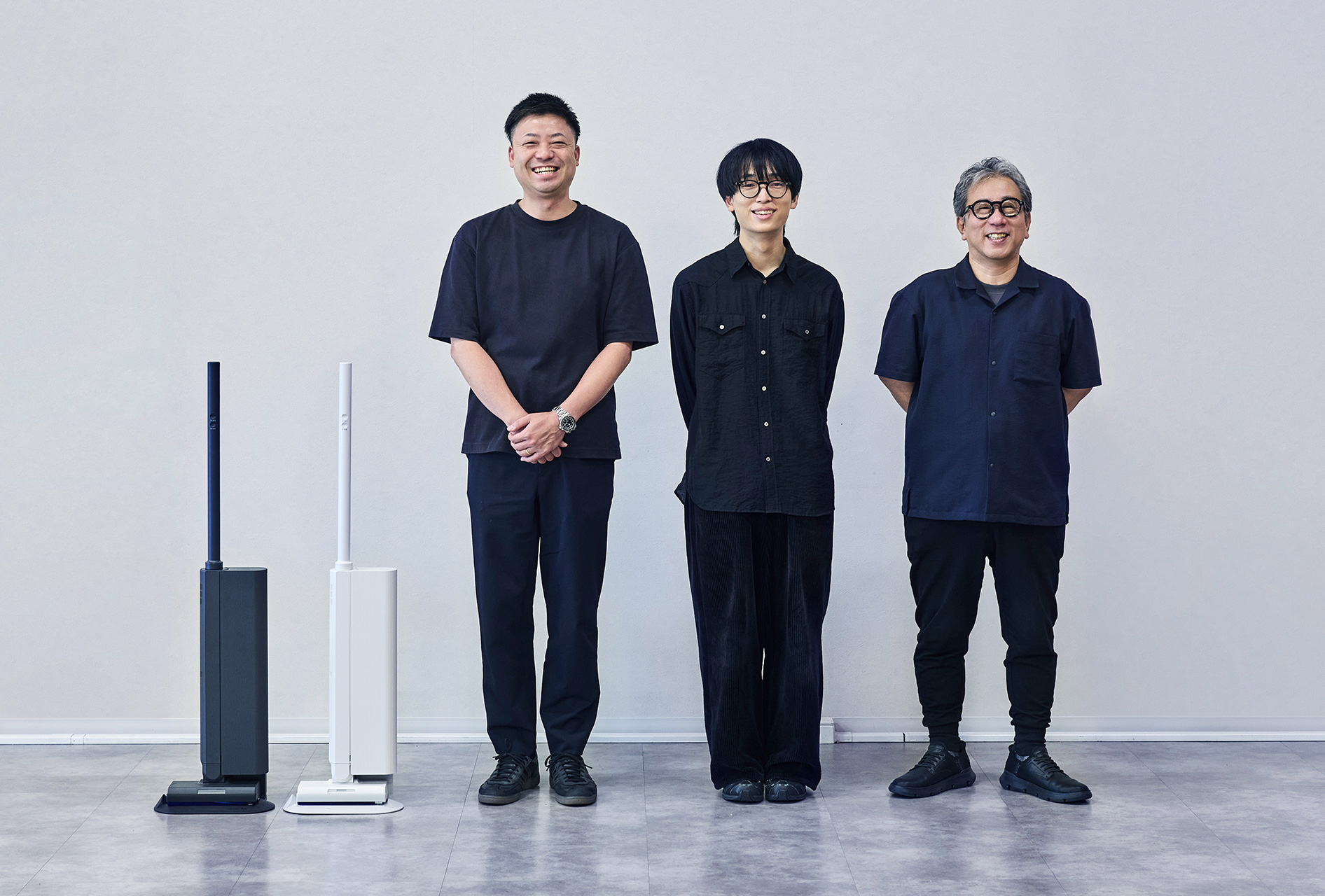
EC-CR1 project team
From left: Kato, Iwai, and Taira.
Envision a vacuum from a design standpoint
A request from the head of the business division to the design division was where it all began. The idea was to set aside all technical constraints for the time being and envision a vacuum for the future from the standpoint of design.
But unbridled creative thinking and creating feasible commercial products are two very different things. The team built numerous design prototypes without waiting to see if the ideas were feasible from a technical standpoint. This meant there was no clear vision of how things would progress.
We felt a sense of unease because the road ahead was unclear.
Kato, who coordinated planning, reflects on how the project progressed:
We first started with a design plan and concept. The technologies and functions to make the vision a reality were assembled later. This was the first time I'd ever worked this way.
Taira, the Design Studio Director, saw the request as an opportunity. At the same time, he felt a sense of responsibility to create and sell a vacuum unlike any other before it.
My thought was that removing the technology side for a moment and thinking only about the design was an opportunity we needed to take advantage of.
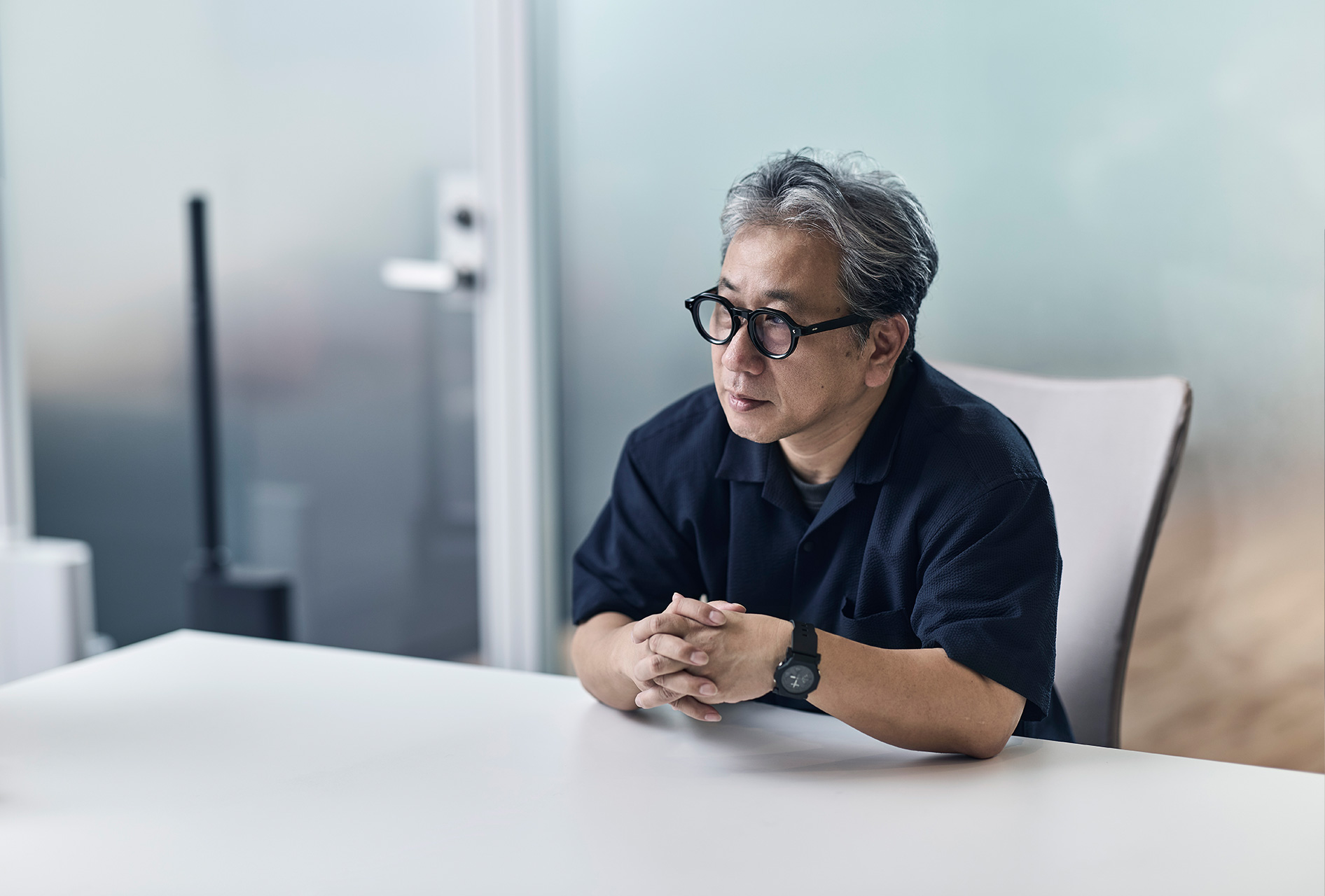
Tomoki Taira
Design Studio Director
Responsible for the direction of the design, Taira was involved beginning with early checks, nudging the team forward by encouraging them to look at where vacuums are used and the behavior of people who use them.
Look to everyday living, not vacuums, for inspiration
So, what provided inspiration for the project? Iwai answered:
Completely unprecedented ideas. Things we’d always wanted to do. We started by bringing all of these things together.
Iwai’s focus was not on vacuums themselves but on where they sit and the people using them. Regardless of the project, Taira always tells his designers to focus not only on the product but also on the environment in which it will be used and the behaviors of the people who will use it.
Turning those observations into products through technology is very much the Sharp way.
This is what Sharp calls insight: looking at familiar things from a slightly different angle.
So, how has vacuuming changed? Research was not the only basis for the design work.
We also did research, of course, but the biggest factors were our own experiences.
Having lived alone since he was a student, Iwai’s approach to vacuuming was different from how it was handled at his parents’ home, where time was spent cleaning every inch carefully and thoroughly. He instead quickly vacuums the spots that need it, whenever he notices them. For him, vacuuming has become less of an ordeal to undertake.
Taira saw the same change from the perspective of the vacuum as a tool. With the shift from canister to stick vacuums, the time spent vacuuming and how vacuums themselves are used have also changed. Nor could they ignore where vacuums sit within the limited space of user residences.
The team’s goal was not to make a vacuum that should be put away. Rather, they wanted to design a vacuum that could stay out in the flow of daily life, ready to use the moment something needed cleaning. This was the vision that guided them.
Finding inspiration in the push broom
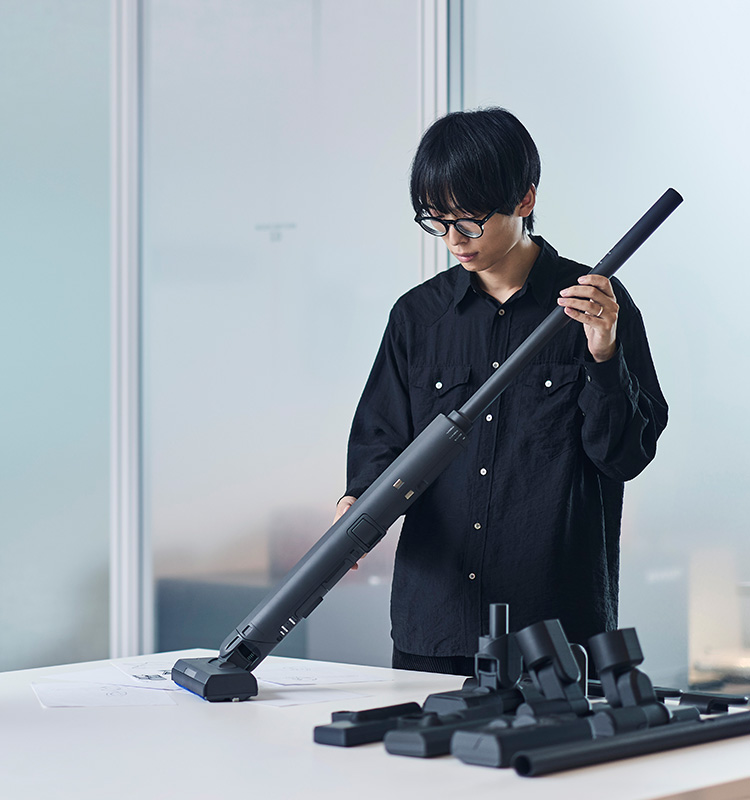
What kind of tool can be moved easily and naturally, even in confined spaces? This search led the team to the push broom, a tool familiar to anyone who did classroom cleaning at school in Japan.
A push broom, something that has been around forever, is easy to use. It’s a way of cleaning familiar to many people in Japan.I thought, something like that would be great.
A push broom is easy for the user to move naturally. Everyone has used one before. They suit users of any height. And they can be used horizontally and vertically. Taira notes that the simpler a tool is, the greater its staying power.
Maybe we should focus not on something mechanical but on something that feels more natural to use, more tool-like?
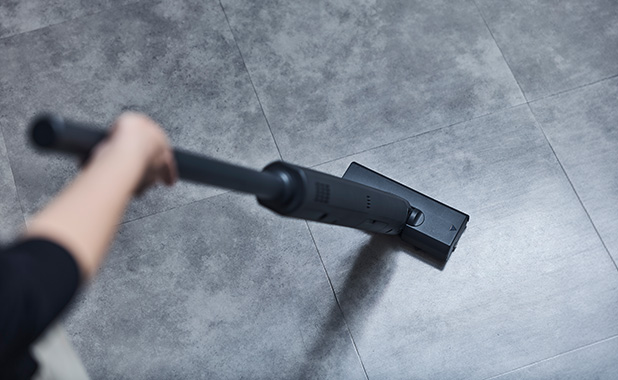
Inspiration was already waiting within the office walls. The structure of the Okunote Head, which Sharp previously designed and sold, became a clue for how to create a feel similar to that of a push broom. The team moved from a T-shaped to an I-shaped head. Aligning the axis of the body with the rotation axis of the head made it easier to handle when changing orientations.
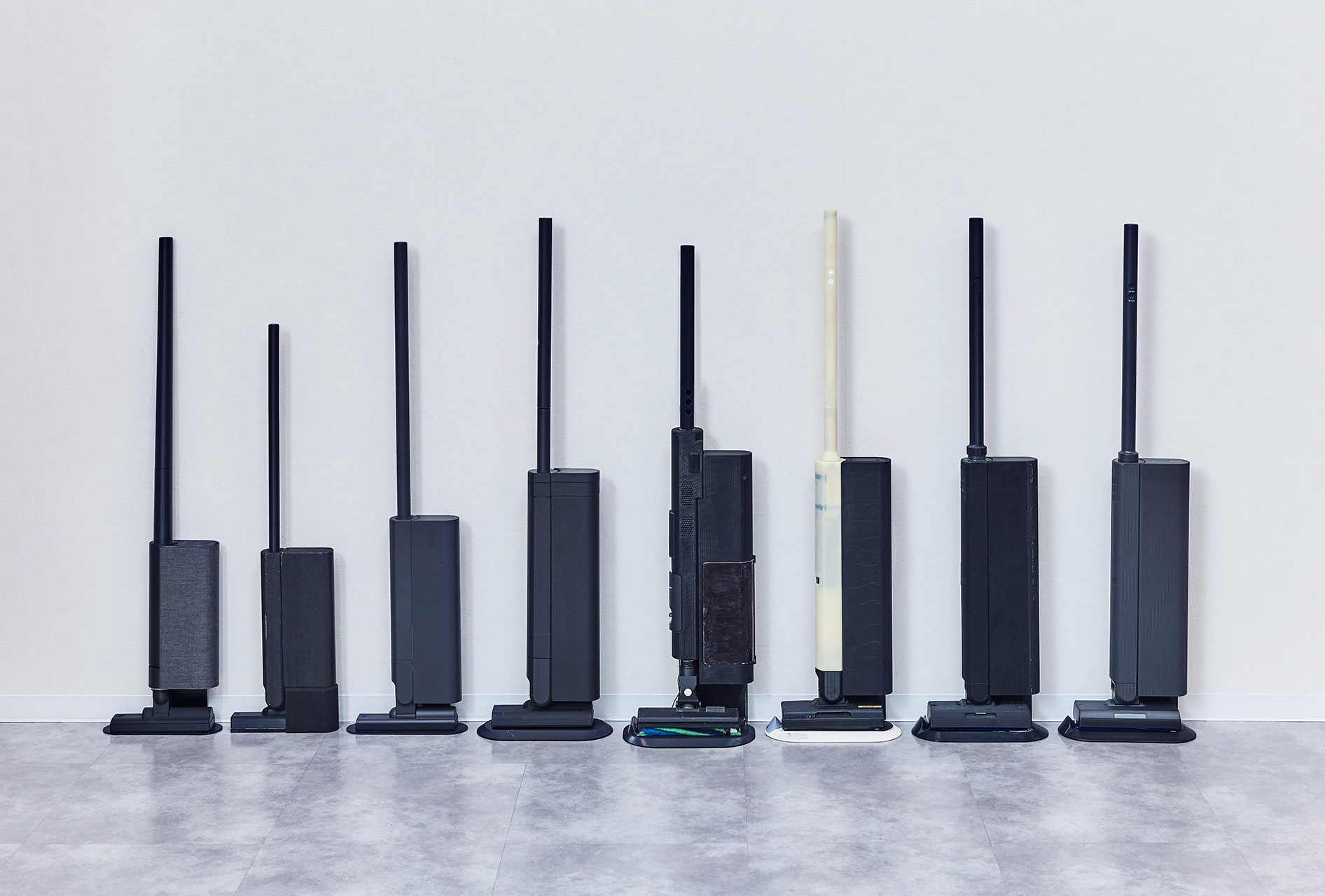
Mockups from the planning stage
Full-size models and technical prototypes allowed the team to find the ideal form while assessing the product’s size, its look, and how it felt to use.
Towards a Furniture-Like Presence
What kind of presence should a vacuum have to stay out in the flow of daily life?
A compact form was a given—something we had considered with our very first proposal.
Kato remembers this well. However, what the team initially envisioned was a product that could fit in the spaces between pieces of furniture. But that was not where they ended up.
Rather than having it fit into the gaps between furniture, we aimed for a presence that could comfortably exist anywhere within everyday living spaces. We thought, wouldn't that make it easier to vacuum?
Instead of one to be hidden away, the team was aiming for a design that could blend seamlessly wherever it was placed.
The form was therefore dictated not by the floor space it occupied but by the thickness of the standing unit.
If the unit is too thick and protrudes too much, how it feels in the space changes; it no longer blends into our living spaces.
Even a slight increase in thickness changes the form and how it feels. Iwai was particularly focused on this point.
For Kato, too, it was not about thinness in comparison.
We were not concerned about saying, this is thinner or this is smaller; we wanted to aim for a size that felt thin even when the unit was seen on its own.
So, how thin would the vacuum have to be to feel thin? There is no standard number of millimeters that defines “thin.” The team therefore evaluated this without using hard numbers.
We took the prototypes home and thought about how it would feel in our everyday lives. We were so familiar with the concept that we would ask our families, who knew nothing about the project, what they thought.
Every time a new prototype was made, the members of the team took it home. Would it get in the way here? That was the criterion for thinness the team had to work to maintain.
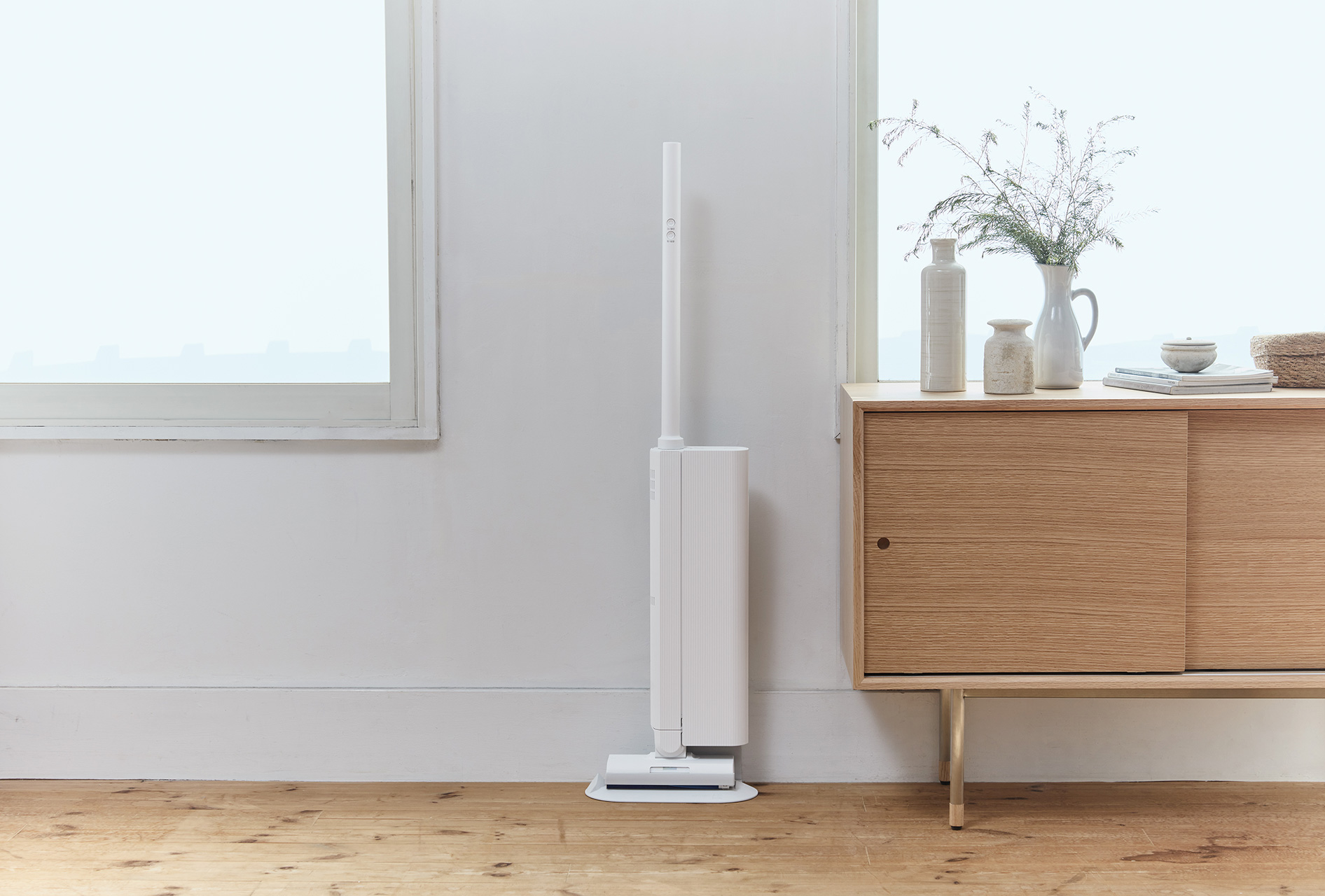
The EC-CR1 against a wall
The goal was a form that could be left out, close to where people pass by every day.
A form idea that changed what a vacuum could look like
The initial idea was for the main unit to be cylindrical and the automatic dust collection station to be square.
The resulting step where the two parts met made it look like two separate units. This, the team felt, gave it a conventional appliance-like appearance. While not an explicit problem, it did not feel right to Iwai.
It was very much just something that came to me at first.
What would the ideal form look like? The answer did not come at his desk. Iwai continued to think with the issue at the back of his mind. Then the answer came to him in an instant.
What if we cut it on these planes?
Iwai sketched it out, went back to his seat, and immediately built a prototype.
The step disappeared, the shape of the station and the main unit came together naturally, and it also worked with the characteristics of the I-shaped head that fits easily into narrow spaces.
A fine texture was also added to the surface, which made future scratches less noticeable. The tactile surface also improved how the vacuum looked when placed inside homes.
The addition of this idea for the shape to the concept we had been building seemed to solve several different issues all at once.
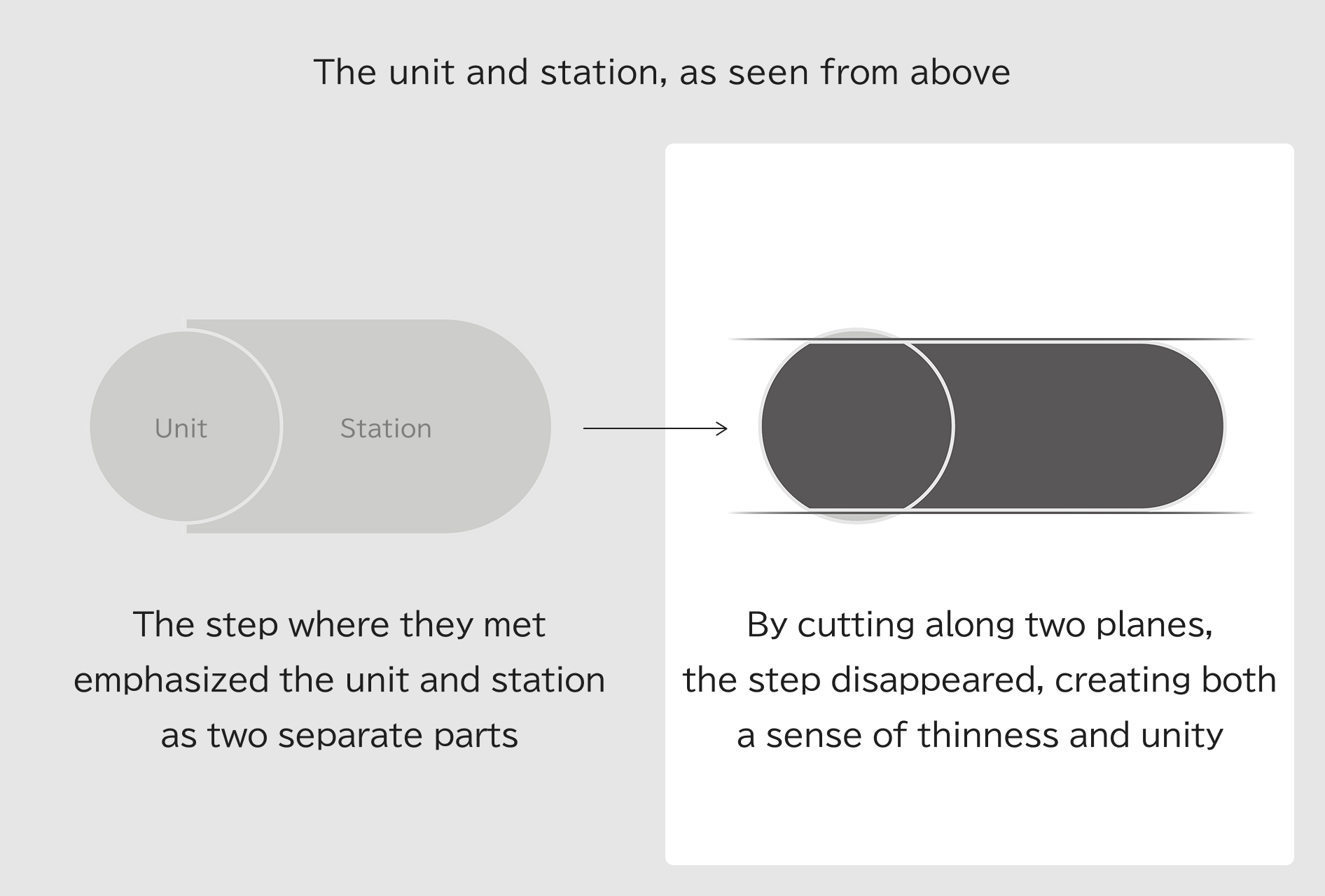
With a purely cylindrical unit, the step remains. But by creating a flat edge, the outlines of the unit and the station become seamless.
Creating a functional product that remains true to the ideals behind it
Design can take you as far as envisioning the ideal form. But to make it a functional vacuum, practical requirements—suction power, battery life, automatic dust collection, vacuum bag housing, and more—then come into play.
The thinness needed for the EC-CR1 was not feasible by simply making existing parts slightly smaller. A configuration known as a multi-suction structure was conceived of in the initial brainstorming stage. This would eliminate the need for a motor in the station and leave the unit's motor alone to handle the automatic dust collection.
Achieving the thinness we wanted wouldn't be possible unless we eliminated certain things.
However, at the time of the initial concept, the essential requirements for the product as a vacuum had not been confirmed.
The dust has to be moved properly. It also has to function properly as a vacuum. The product also has to have a sufficient battery life.
Normally, a concept is developed after the technical requirements are within view. With this project, that order was reversed.
Solving one challenge meant a new challenge appearing in its place. And with each solution, the product grew thicker. The thicker it became, the further the product deviated from the intended form. This cycle repeated itself over and over.
With this project, we flexibly assessed the technical requirements and were persistent about envisioning an ideal vacuum.
A key to accelerating the design cycle became the 3D printer that Iwai was adamant about. Prior to its introduction, a reservation was needed for milling; it took several days for a new prototype to arrive. But with the introduction of the 3D printer, the design team was able to build prototypes on their own.
We weren’t able to build prototypes quickly in the past. Now, we can immediately turn an idea into a physical form.
This change in how often the team could go back and forth between their hypothetical ideals and the real world helped make the product a reality.
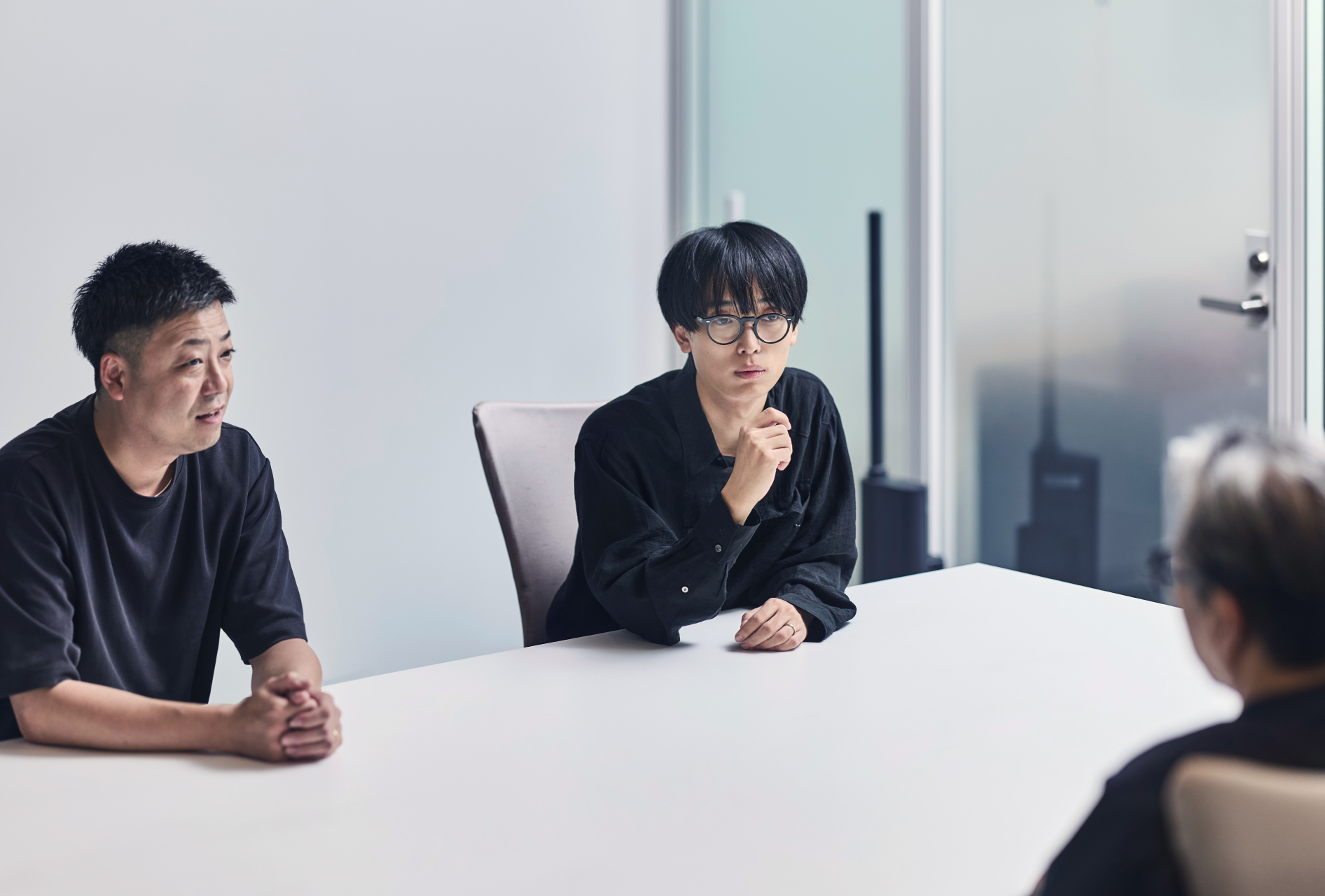
Yusuke Iwai
Product Designer
The first to envision the new design, Iwai quickly gave it form and continued to make decisions about what to prioritize and what to discard when it came to structure and specifications.
Initial internal reviews gave confidence to the envisioned design
Although the new form felt promising, it was unclear how it would be received internally. For Kato, the initial internal reviews were the first time he felt the form was truly on the right track.
Of all the projects I’ve been involved in, this was the best reaction I’d ever seen to a design.
Senior management indicated their support, asking the team to add white to the lineup that previously only included dark gray, and recommending that the vacuum be pushed front and center.
The positive assessments of the design in these reviews were later affirmed in the form of an external award—the EC-CR1 received a 2026 Good Design Award. The concept behind the product also resonated strongly in negotiations with mass retailers.
To Taira, the lack of opposition to the design was not a coincidence. The forms vacuums take and how they are used draw on assumptions that have continued for years. The silhouette of the handle. The thickness of the grip. The shape of the nozzle. Changing any of these individually, Taira stresses, would present significant hurdles.
That is why they showed the overall form first, instead of focusing on the details.
The moment the silhouette was shown, everyone knew, ‘This is going to be great.’ Just looking at the silhouette, they could imagine where it would sit in a living space and how it would be used.
The difference was immediately clear.
Even when there were technical challenges later, the discussions that followed always focused not on how to change the design for performance’s sake but on how to make the envisioned form work.
There was very little in the way of compromising on the design. We continued to think about what to keep and what to remove in order to make our design a reality.
The results of the initial reviews were not just a positive response. A shared understanding was gained throughout the development process that this design form would need to be preserved as the EC-CR1 became a functional, commercial product.
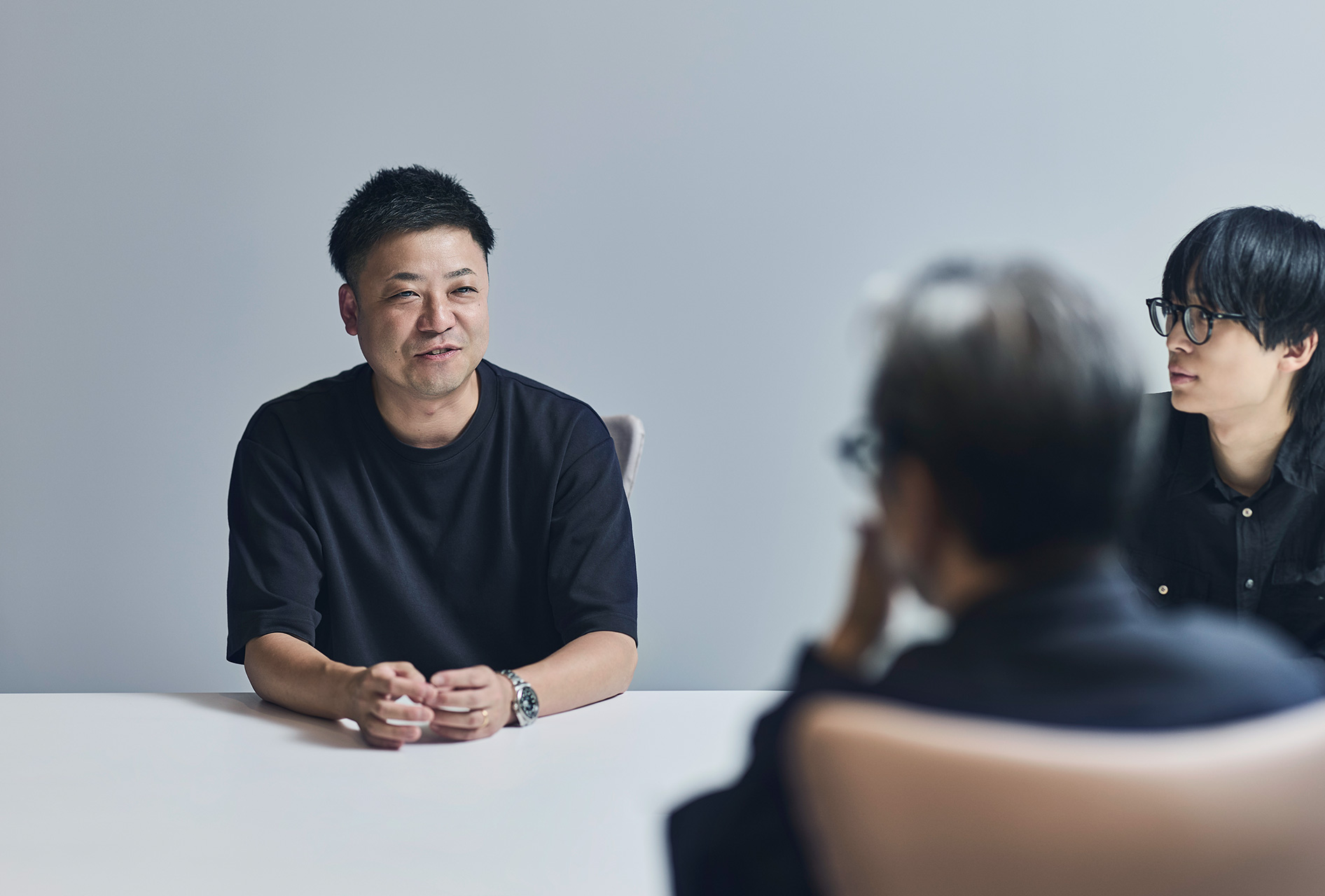
Atsushi Kato
Vacuum Cleaner Planning Coordinator
Kato was responsible for receiving design proposals, managing the costs and other practical aspects of development, and handling everything from introducing the product to mass retailers to announcements for the press.
Question the norm to create new value
At the end of the interview, the team was asked what advice they would give to someone trying to create new value in a field where numbers alone no longer tell the whole story.
Taira responded:
When looking at the familiar, first take a step back.
Home appliances are necessities of life. They may seem—for decades—unchanged, but thanks to small details people working on them notice, they do change little by little. It is important to observe the people using them and the space they are in, and to broaden your perspective. You will find clues when you change your vantage point.
Kato offered his advice:
Question what seems most like common sense.
Vacuum cleaners are noisy. Adding an automatic dust collection station adds to their footprint. When we question assumptions like these, a new question arises: how will the world change?
And finally, Iwai said:
Things around us may seem finished, complete. But there is always room for change.
When asked what changed after experiencing this project, Iwai also noted that it was always taken for granted that design works based on the plans provided by engineering. But that changed, putting Iwai in a proactive position. It led him to look beyond design and consider what, including the necessary technical specifications, a product needed to be.
Putting the user's lifestyle and needs at the core of the concept led to a design that is as easy to use as a push broom and that can be left out in plain view.
By first indicating what the future of the vacuum should look like and repeatedly experimenting with technology and planning, the team designed a new form of vacuum that is ready for use whenever it is needed.
Good Design Award|Cordless vacuum cleaner [RACTIVE Air STATION] <EC-CR1>
Recommend
-
Reimagining the Washing Machine through Steel to Transform an Ideal Vision Into a Product Designed for Everyday Living
ES-8XS1 Compact Drum Washer/Dryer
- Product
-
Opening a dialog with society to discover and define new value
todokuto
sanitary product dispenser- UX
- Product
- Communication
-
Redefining the A4 Multifunction Printer Through Radical Compactness
BP-C131WD A4 Color Multifunction Printer
- UX
- Product